

By Jeff White (jwhite@virginia.edu)
VirginiaSports.com
CHARLOTTESVILLE –– Among those who will be recognized during the Virginia-Duke football game Saturday at Scott Stadium are Harrison Davis, Stanley Land, Kent Merritt and John Rainey. When they enrolled as first-year students in 1970, they became the first African-Americans to receive football scholarships from the University, and their historic impact on the program has been well-chronicled.
Not so widely known is the story of Gary Ham, who’ll be honored with them Saturday.
Ham enrolled at UVA on an Army ROTC scholarship in 1969, with no intention of playing football. On his floor in Echols dormitory were a couple of football players, though, and Ham watched games from the stands at Scott Stadium that fall.
The Cavaliers dropped their final six games and finished 3-7. Ham thought he might be able to play at the college level, and so he tried out for the team early in the spring semester of his first year. The coaches liked what they saw and invited Ham, a 5-foot-10 cornerback, to join the program as a walk-on.
In 1970, when Davis, Land, Merritt and Rainey played for Virginia’s freshman team, whose coach was Al Groh, Ham was the only African-American on the varsity. The Wahoos had a new head coach, Don Lawrence, and he “was the one that pretty much kind of recruited me and encouraged me to stay with it,” Ham, who wore jersey No. 31, recalled in a recent Zoom interview.
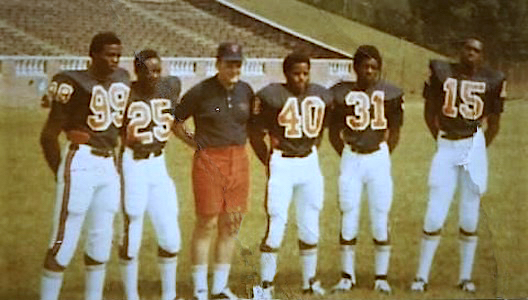
To be saluted as one of the program’s pioneers will be an immense honor, said Ham, who lives in the Rochester, N.Y., area with his wife, the former Harriet Pierce. They’ve been active in Christian ministries for more than four decades.
“I just feel humbled by the whole thing,” said Ham, a pastor who turns 70 next month. “There’s four major things that I’m so thankful for about my experience at UVA, and now for this to happen, it’s overwhelming.”
First, Ham said, “I got a chance to play Division I football. How many kids get a chance to play Division I football?”
Second, UVA “prepared me for my life work,” Ham said. “You get four years of college education and it gives you something, it prepares you for life, for work. It helps you learn how to do things that you need to do if you’re going to achieve something in life. And so I went through ROTC and that prepared me to serve our country, which I was very proud of.”
UVA also “was the place where I met my wife, and we’ve been married now for 47 years,” Ham said. “She graduated the same year that Kent and [the other three African-American players] graduated. She was in that class. But the most important thing that happened at UVA was that in my senior year I re-dedicated my life to Jesus Christ.”
Ham said he heard a preacher on Grounds during Black History Month in early 1973, “and I realized then and there that I was falling short of God’s plan for my life, and that was a major turnaround of my life. I recommitted my life to Jesus Christ.”
For his final two years at UVA, said Ham, a sociology major, he was on football scholarship. A reserve as a junior in 1971, he headed into his senior season hoping to carve out a significant role on the team. It didn’t happen.
“My junior year was wonderful,” Ham said. “You could really begin to see some potential, and actually I had traveled with the team [to road games] in my junior year. But I came to camp in 1972 injured.”
He’d sprained his knee playing sandlot football in Hampton. “It was one of the worst decisions of my life,” Ham said, shaking his hand. “The coaches were upset with me, and I was upset with myself.
“I wasn’t a Kent Merritt or a John Rainey. Those guys were amazing athletes. I was just a hard-working guy that had some skills. So when I came to camp my senior year with that kind of injury, then my chances of doing anything were really minimized.”